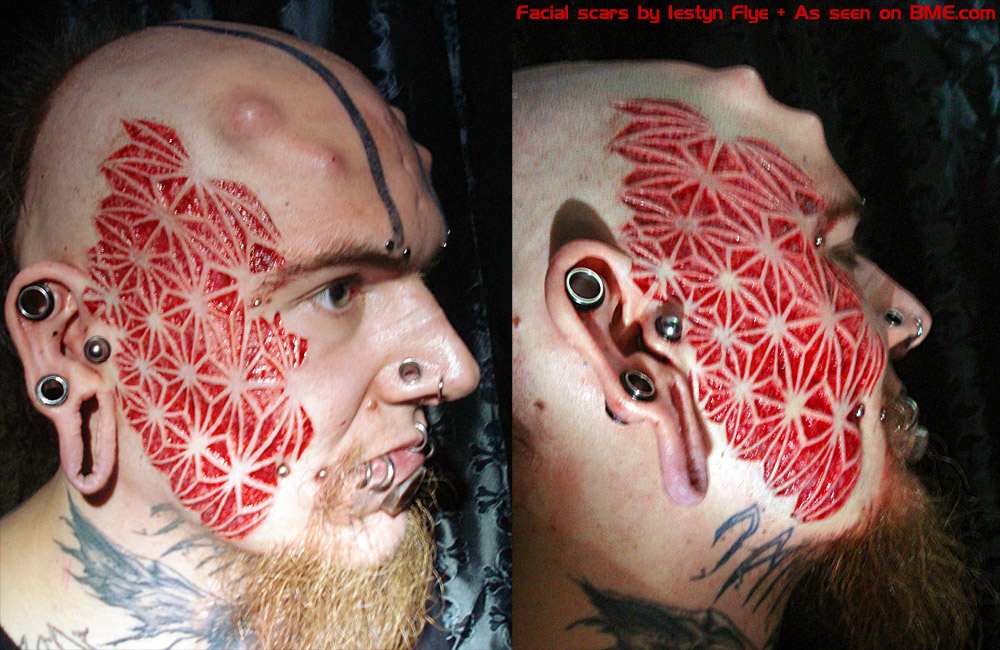
This has to be one of the largest examples of [voluntary] skin removal on a face to date, at least in a single session. It was done by Iestyn Flye –who is normally based at London’s Divine Canvas, but tours extensively so visit him on Facebook for more information no matter where you might be — on Marc at Copenhage Body Extremes (bodyextremes.com). The design is based on a Japanese holy hemp leaf pattern. I can’t wait to see this healed, and will definitely post a follow-up when I can (although if you look at the previous scar that runs across the nose, you can get a good idea of what to expect) — I expect the sort of visage that looks like Freddy Krueger from a distance, and then transforms from horrific to beautiful as you get closer. Click for a larger look.
Tuesday, March 5, 2013
Wednesday, February 27, 2013
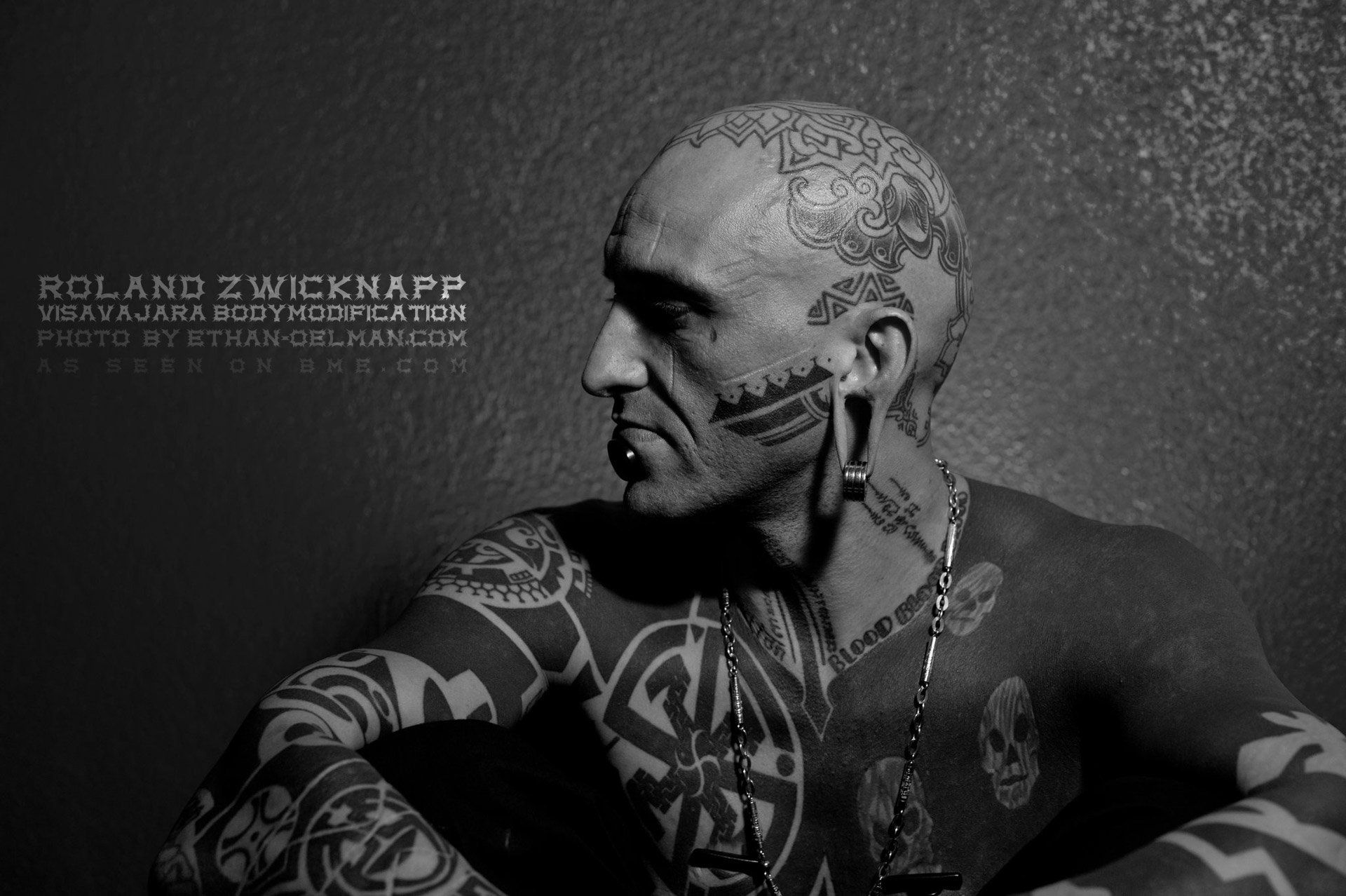
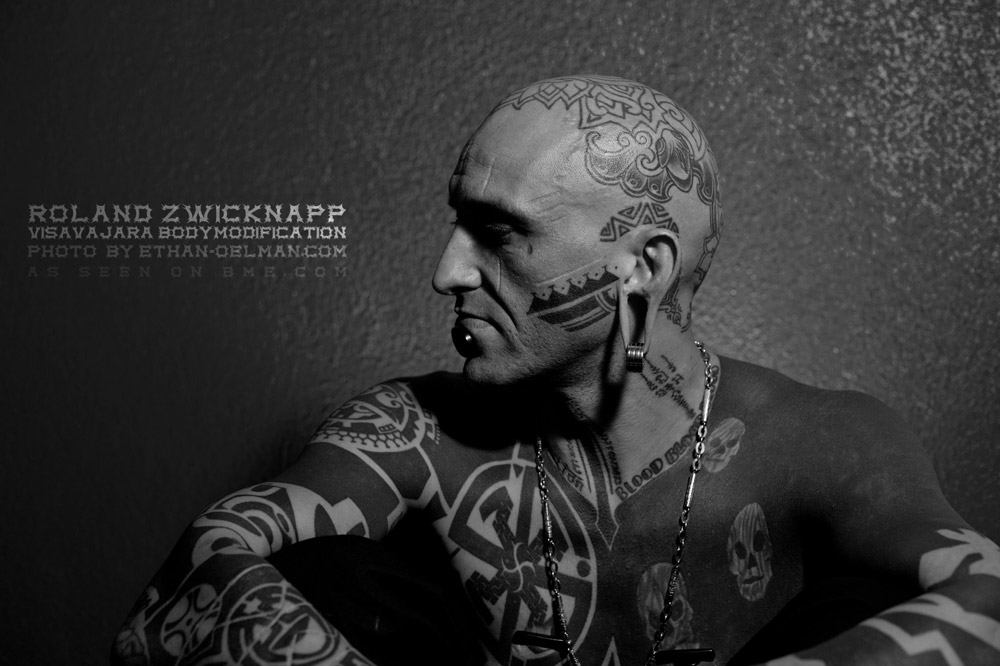
Roland Zwicknapp Wallpaper
At the other end of the spectrum of heavily modified people, you’ve got people like Roland Zwicknapp of Visavajara (visavajara.com). He’s let me share this gorgeous portrait shot of him a few years ago by Ethan Oelman. Click the image below to see it uncropped, or save it from this link for a desktop wallpaper sized image.


Thursday, February 21, 2013
Black Dahlia Smile Brands
Cut in half and thus first believed to be a store mannequin when discovered, the body of Elizabeth Short, better known as The Black Dahlia, was found in a truly horrific state. Quoting from Wikipedia,
Short’s severely mutilated body was severed at the waist and completely drained of blood. Her face had been slashed from the corners of her mouth toward her ears, creating an effect called the Glasgow smile. Short also had multiple cuts on her thigh and breasts, where entire portions of flesh had been removed.
I mention this before posting a picture of Kenny Wagner’s new brands, done by Jeremy Pauley of Modern Relic Modifications, so you don’t jump to the conclusion that he’s a Joker (as in Batman‘s nemesis) superfan. Kenny tells me that he’s been long fascinated by the look of an expanded smile with “a darker twist to it” and after coming across images of the Dahlia cuts in horror movies the idea became set in his mind. The horror twist works especially well due to his black eyeball tattoos (the left done by Jeremy who did the brands, and the right by Chance Davis) — although he does admit it gets a little annoying having to constantly hear about Heath Ledger (“…but I’m quite polite most of the time, or sometimes even act like I’ve never even seen the movie!”).


Thursday, February 7, 2013
Healing Facial Scars
I think most people know of the Maori tradition of facial tattooing or Moko, but I suspect most people see this tradition as being about tattooing (as in using needles to poke a design using ink into the skin). At its roots though it’s more likely an extension of their tradition of wood carving — similar patterns are chiseled into their homes, furniture, and boats. Mokos appear to have began by applying this wood art to the human body, literally chiseling or carving designs into the face, using similar tools for similar results. Some time after this practice began, ink was the added to the scars, making them more visible, and in time the tradition slowly moved away from scarification-based methods to tattooing-based ones. Some early photos show the three dimensional nature of Mokos created using the ink-rubbing scarification technique, although by the time Western anthropologists began documenting the practice it was already falling out of fashion.
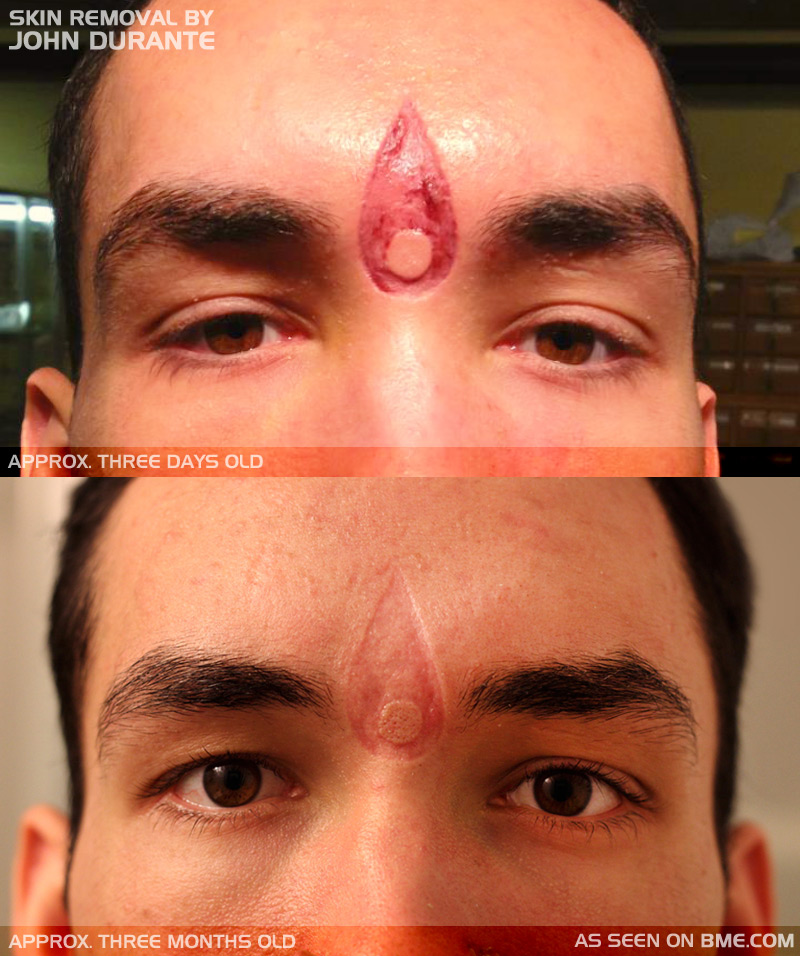
Anyway, I was reminded of that history when I saw this skin peel done by John Durante (of Seattle-based jewelry company Evolve), which you can see here both fresh and well into healing. I really like the way he has used a sort of “reverse negative space” by cutting out a simple shape, but leaving a circle of skin in the middle untouched. As to why these facial scars inset rather than raising (as most scars do), it’s possible that it’s some evolution that makes facial injuries less likely to disfigure, it could be due to there being less subcutaneous fat, or it could be due to the vascular nature, but I don’t really have a good explanation as to why the majority of facial scars are “innies” rather than “outies”. If there are any medically aware readers that want to save me some googling, I’m like a Ferengi… all ears.
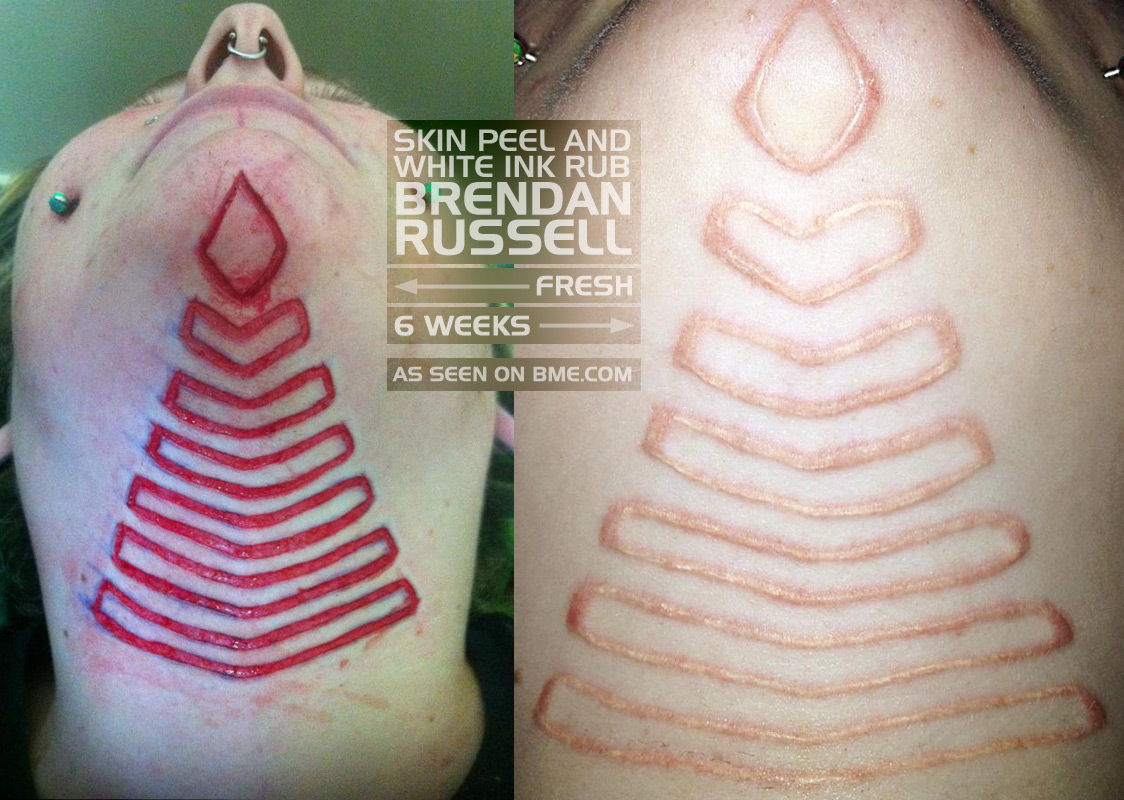
You don’t have to move far off the face for the scarred skin to start being more likely to raise than stay inset. Here’s another good example of a scar showing fresh versus healing, a throat piece done by Brendan Russell of Tribal Urge in Newcastle, NSW, Australia. The sharp-eyed will notice that this isn’t just a skin removal scar by the way — it’s also an ink rubbing done with white ink, which has the interesting side-effect of making the age of the scar difficult to eyeball.